
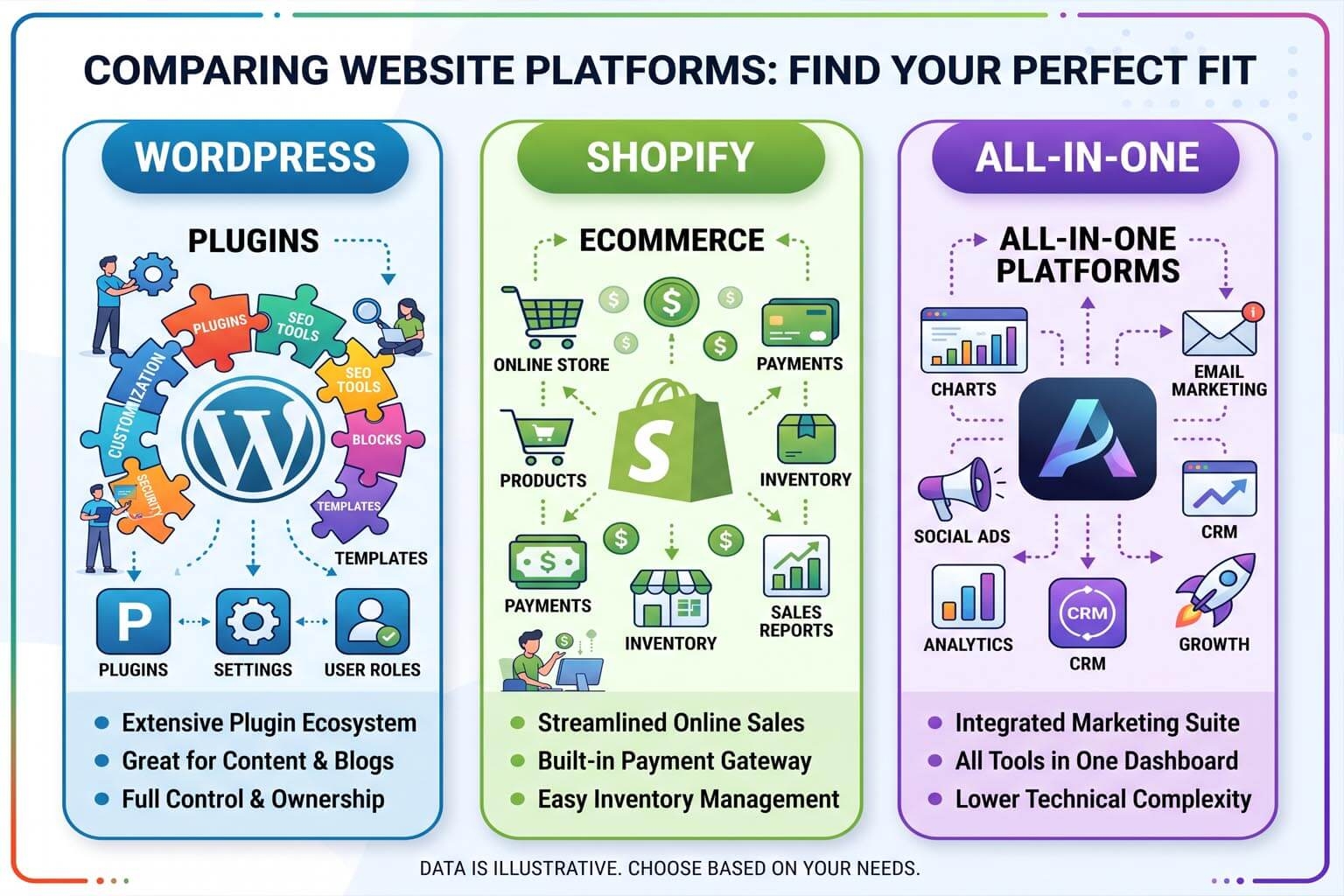
WordPress vs Shopify vs Modern All-in-One Platforms
Choosing the right platform for your online business has become more important than ever. While WordPress and Shopify continue to dominate the market, a new generation of all-in-one platforms is changing how businesses build and manage their websites.
Each platform has strengths, but they are designed with different goals in mind.
Understanding those differences can help you choose the right solution for your business.
WordPress
WordPress powers a large percentage of websites on the internet because it is flexible and supported by a massive ecosystem of themes and plugins.
Advantages
- Large community and ecosystem
- Thousands of plugins and themes
- Highly customizable
- Suitable for blogs and business websites
Challenges
- Heavy reliance on plugins
- Regular updates and maintenance
- Security depends on plugins and configuration
- Performance can degrade as more plugins are installed
- Development costs often increase over time
WordPress works well for many businesses, but as websites become more complex, managing plugins and compatibility can become a significant challenge.
Shopify
Shopify focuses primarily on ecommerce.
It offers a streamlined way to launch an online store without worrying about server management.
Advantages
- Easy to launch
- Reliable hosting
- Strong ecommerce features
- Large app marketplace
- Secure payment integrations
Challenges
- Monthly subscription costs
- Additional costs for apps
- Limited flexibility compared to self-hosted platforms
- Advanced customization often requires developers
- Businesses can become dependent on third-party applications
Shopify is an excellent ecommerce solution, but businesses often expand their technology stack as their requirements grow.
Modern All-in-One Platforms
Modern all-in-one platforms take a different approach.
Instead of combining multiple products, plugins, and third-party services, they integrate everything into a single platform.
Website management, ecommerce, SEO, users, content, products, and business operations are managed together.
The goal is not simply to build websites.
It is to operate online businesses more efficiently.
Advantages
- One platform for websites, ecommerce, and SEO
- Lower operational complexity
- Fewer third-party dependencies
- Faster deployment
- Centralized management
- Lower maintenance overhead
- Better scalability
Instead of assembling separate tools, businesses can focus on growing their products and customers.
Feature Comparison
| Feature | WordPress | Shopify | Modern All-in-One Platform |
|---|---|---|---|
| Website Builder | ✔ | ✔ | ✔ |
| Ecommerce | Plugin Required | Built In | Built In |
| SEO Tools | Plugin Based | Built In | Built In |
| Multiple Dashboards | Often Yes | Sometimes | Yes |
| Plugin Dependency | High | Medium | None |
| Multi-site Support | Available | Limited | Built In |
| Multi-seller Support | Plugin Required | App Required | Built In |
| Physical Products | ✔ | ✔ | ✔ |
| Virtual Products | Plugin Required | ✔ | ✔ |
| Subscription Products | Plugin Required | App Required | ✔ |
| Trial Support | Plugin Required | App Required | ✔ |
The Cost of Fragmentation
Many businesses underestimate the hidden cost of using multiple systems.
A typical website may require:
- Website hosting
- CMS
- Ecommerce plugins
- SEO plugins
- Security plugins
- Backup tools
- Marketing software
- Analytics integrations
- Developer support
Each additional component increases maintenance, compatibility risks, and operating costs.
Modern platforms reduce much of this complexity by providing these capabilities from one environment.
Why Centralization Matters
Most websites share many common resources.
JavaScript libraries, CSS frameworks, business logic, and platform components are often duplicated across thousands of websites.
Modern centralized platforms avoid unnecessary duplication by sharing these resources while allowing every business to maintain its own branding, products, content, and customer experience.
This approach can improve efficiency while reducing infrastructure and maintenance costs.
Where Round Rockk Fits
RoundRockk represents this newer generation of all-in-one platforms.
It combines website building, ecommerce, content management, and SEO into a centralized platform designed for modern businesses.
Businesses can manage physical, virtual, and subscription products, including trial offerings, from dedicated dashboards for administrators, staff, sellers, and users.
Each business can operate multiple websites and multiple sellers without relying on large collections of plugins or third-party applications.
Unlike many newer platforms, RoundRockk also keeps the management experience familiar by taking inspiration from interfaces businesses already know, such as WordPress, cPanel, and Webflow. This helps reduce the learning curve while providing a modern architecture underneath.
Which Platform Is Right for You?
There is no single platform that fits every business.
- Choose WordPress if you need maximum flexibility and are comfortable managing plugins and ongoing maintenance.
- Choose Shopify if your primary focus is launching an online store quickly.
- Choose a modern all-in-one platform if you want to simplify operations, reduce maintenance, centralize website management, and build on an architecture designed for long-term growth.
As businesses continue to evolve, the trend is moving away from managing multiple disconnected systems toward centralized platforms that bring websites, ecommerce, SEO, and business operations together.
That is the direction modern web infrastructure is heading, and it is the philosophy behind Round Rockk.
