
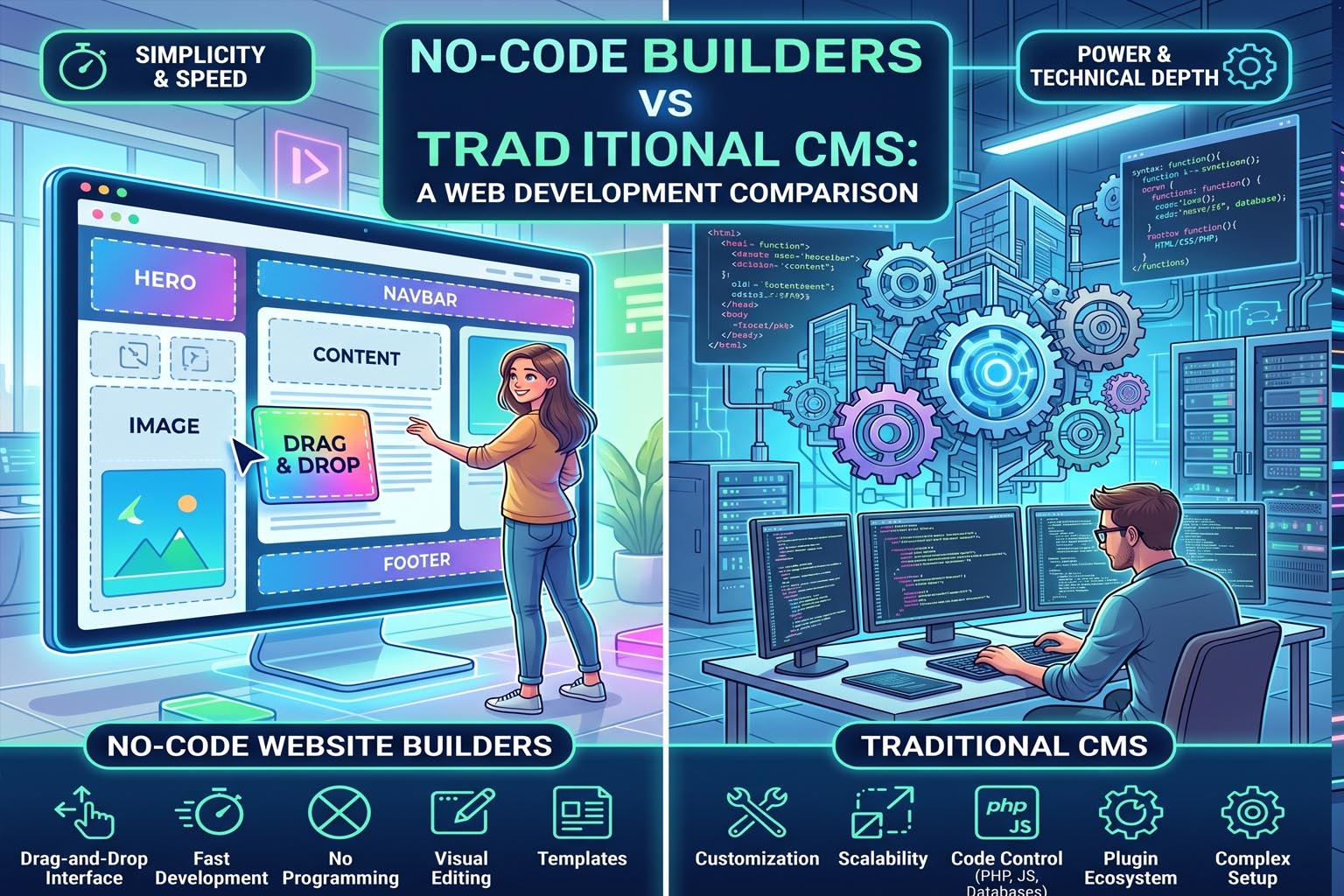
Why No-Code Website Builders Are Replacing Traditional CMS Platforms
Traditional CMS platforms transformed website development by making content management easier for businesses and publishers. Platforms like WordPress helped millions of websites go online without requiring businesses to build systems entirely from scratch.
However, as digital experiences become more complex, businesses are increasingly moving away from traditional CMS workflows toward modern no-code website builders.
In 2026, businesses want platforms that are faster to manage, easier to customize, visually intuitive, scalable, and less dependent on plugins, developers, and fragmented systems.
No-code website builders are becoming the preferred choice because they simplify website creation while giving businesses greater operational control.
The Problem With Traditional CMS Platforms
Traditional CMS platforms were originally designed for publishing content. Over time, businesses started extending them to support ecommerce, landing pages, marketing systems, memberships, analytics, and customer engagement.
As requirements grew, so did complexity.
Many businesses now face challenges such as:
- plugin dependency
- developer reliance
- fragmented workflows
- security vulnerabilities
- complicated maintenance
- inconsistent design systems
- slower performance
What starts as a simple website often becomes difficult to manage as the business scales.
Why Businesses Prefer No-Code Website Builders
1. Faster Website Development
Traditional website development often requires:
- coding knowledge
- developer support
- theme customization
- plugin configuration
- template editing
No-code website builders simplify this process through visual interfaces and structured workflows.
Businesses can:
- create pages faster
- manage layouts visually
- customize designs without coding
- launch updates quickly
- reduce development bottlenecks
This dramatically improves operational efficiency.
2. Visual Website Management
Modern businesses increasingly prefer visual editing over code-heavy workflows.
No-code platforms provide:
- drag-and-drop sections
- live previews
- visual customization
- reusable templates
- responsive layout controls
Instead of editing files manually or depending on developers, businesses can manage websites directly through intuitive interfaces.
This makes website management more accessible to:
- startups
- ecommerce businesses
- agencies
- marketers
- content teams
- small business owners
Reduced Dependency on Plugins and External Tools
One of the biggest limitations of traditional CMS platforms is plugin dependency.
Businesses often install multiple plugins for:
- SEO
- forms
- ecommerce
- analytics
- security
- page building
- performance optimization
Over time, this creates:
- maintenance complexity
- compatibility issues
- security risks
- performance problems
Modern no-code platforms increasingly provide integrated functionality directly inside the system.
This reduces operational fragmentation and simplifies long-term management.
Better Website Consistency
Traditional CMS platforms often suffer from inconsistent layouts and fragmented design structures caused by multiple plugins, themes, and custom modifications.
No-code platforms provide more structured design systems through:
- reusable components
- template-based layouts
- centralized styling
- visual controls
- standardized sections
This improves:
- branding consistency
- user experience
- website maintainability
- scalability
No-Code Platforms Are More Business-Focused
Businesses today need more than content publishing.
They require:
- ecommerce functionality
- SEO management
- customer engagement
- analytics
- responsive design
- landing pages
- security systems
- centralized operations
Modern no-code platforms are increasingly built around complete business workflows instead of isolated content management.
This makes them better suited for growing businesses.
Why Visual Customization Matters
Businesses want more control over website appearance without depending heavily on developers.
Modern no-code website builders allow businesses to:
- edit layouts visually
- customize sections
- manage spacing and styling
- update branding quickly
- build responsive pages
- preview changes instantly
Visual customization reduces development delays while improving agility.
How Round Rockk and Rockk Craft Support Modern Website Building
Round Rockk and Rockk Craft are designed for businesses that want modern website management without the complexity of traditional CMS systems.
The platform combines:
- no-code workflows
- WYSIWYG website building
- template-based page creation
- integrated ecommerce
- visual customization
- SEO controls
- security-focused architecture
- centralized management
into one scalable environment.
WYSIWYG Website Building With Design Flexibility
Rockk Craft provides visual website management through:
- drag-and-drop sections
- reusable templates
- live previews
- responsive layouts
- Bootstrap-based styling controls
- customizable headers and footers
- dynamic content sections
Businesses can create professional websites while maintaining greater design flexibility and operational efficiency.
Integrated Ecommerce and Website Management
Modern businesses no longer want separate systems for websites and ecommerce operations.
Rockk Craft combines:
- website management
- ecommerce functionality
- SEO tools
- customer engagement
- analytics
- content publishing
inside one centralized platform.
This simplifies workflows while improving scalability.
Security and Scalability for Growing Businesses
Traditional CMS platforms often require multiple plugins and external tools for security management.
Rockk Craft includes built-in:
- firewall protection
- IP blocking
- captcha systems
- OAuth2 authentication
- access controls
This helps businesses maintain secure operations while reducing external dependencies.
The Future of Website Development
The future of website development is moving toward:
- no-code workflows
- visual customization
- integrated ecosystems
- centralized management
- scalable infrastructure
- simplified operations
Businesses increasingly prefer platforms that reduce technical complexity while maintaining flexibility and customization.
No-code website builders are no longer limited to simple websites. They are becoming complete business management ecosystems.
Conclusion
Traditional CMS platforms helped shape the modern web, but growing businesses increasingly need faster, more scalable, and easier-to-manage solutions.
No-code website builders are replacing traditional CMS workflows by simplifying website management, reducing plugin dependency, improving visual customization, and integrating business operations into one platform.
Round Rockk and Rockk Craft are designed to support this new generation of website management with integrated no-code tools, WYSIWYG design controls, ecommerce functionality, and security-focused architecture.
FAQ
What is a no-code website builder?
A no-code website builder allows users to create and manage websites visually without writing code.
Why are businesses moving away from traditional CMS platforms?
Businesses want simpler management, fewer plugins, better scalability, visual editing, and reduced dependency on developers.
Are no-code website builders suitable for ecommerce?
Yes. Modern no-code platforms increasingly combine website management and ecommerce functionality into integrated systems.
What are the benefits of visual website building?
Visual website building improves speed, usability, customization, and operational efficiency.
Does Rockk Craft support visual website editing?
Yes. Rockk Craft provides WYSIWYG visual editing, drag-and-drop sections, reusable templates, and responsive layout controls.
