
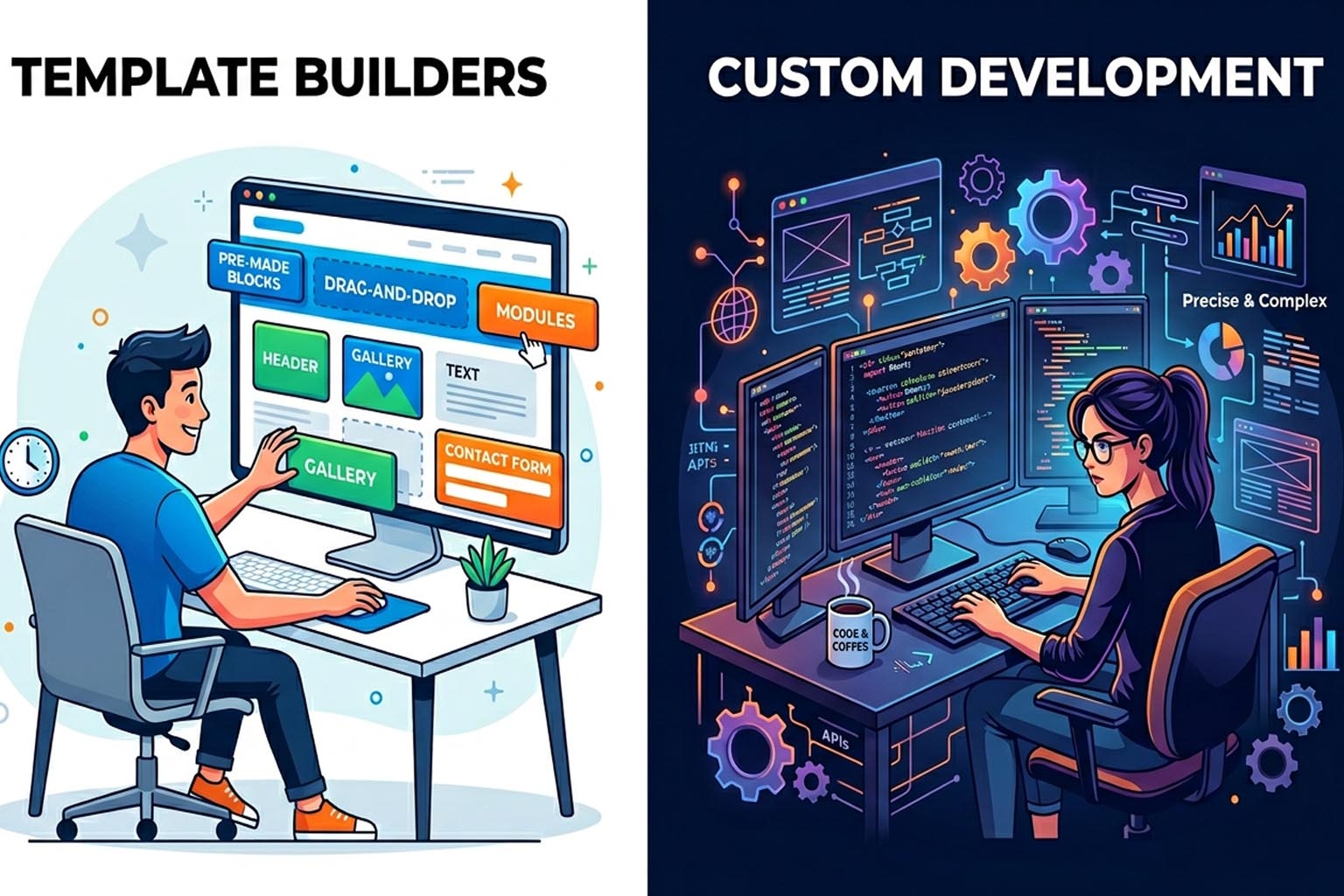
Template-Based Website Builders vs Custom Development: Which Is Better?
One of the first decisions businesses face when building a website is choosing between a template-based website builder and custom website development.
For years, custom development was considered the gold standard. Businesses hired developers, designers, and agencies to create websites from scratch. While this approach offers flexibility, it often comes with higher costs, longer timelines, and ongoing maintenance requirements.
Today, modern website builders have evolved significantly. Advanced no-code platforms now provide visual customization, reusable templates, integrated ecommerce, SEO controls, and responsive design capabilities that rival many traditionally developed websites.
So which option is better for modern businesses?
The answer depends on your goals, budget, timeline, and long-term growth strategy.
What Is a Template-Based Website Builder?
A template-based website builder provides pre-designed layouts and reusable components that allow businesses to create websites visually.
Instead of starting from a blank canvas and writing code, users can:
- Select templates
- Customize layouts
- Edit content
- Modify styling
- Add ecommerce functionality
- Publish pages visually
Modern website builders provide significantly more flexibility than earlier generations of drag-and-drop tools.
Many now support:
- Visual editing
- Responsive layouts
- SEO controls
- Ecommerce management
- Custom branding
- Dynamic content
This allows businesses to create professional websites without extensive development resources.
What Is Custom Website Development?
Custom website development involves creating a website from scratch using programming languages and development frameworks.
A custom project typically includes:
- UI design
- Frontend development
- Backend development
- Database management
- Hosting configuration
- Security implementation
- Testing and deployment
This approach gives businesses complete control over functionality and architecture but requires greater investment in time, technical expertise, and ongoing maintenance.
Comparing Template-Based Builders and Custom Development
1. Development Speed
Template-Based Website Builders
Most websites can be launched within days or weeks.
Businesses can:
- Choose a template
- Customize content
- Configure ecommerce
- Publish quickly
This significantly reduces time-to-market.
Custom Development
Custom projects often require:
- Planning
- Design
- Development
- Testing
- Revisions
Development timelines can range from several weeks to several months.
Winner
Template-Based Website Builders
For most businesses, speed is a major advantage.
2. Cost
Template-Based Website Builders
Costs are typically predictable and lower.
Businesses avoid:
- Large development fees
- Custom coding expenses
- Extensive maintenance costs
This makes them attractive for startups and growing businesses.
Custom Development
Custom websites often involve:
- Developer salaries
- Agency costs
- Ongoing maintenance
- Infrastructure expenses
The total cost of ownership is usually much higher.
Winner
Template-Based Website Builders
For most businesses, the return on investment is significantly better.
3. Flexibility
Template-Based Website Builders
Older builders often had customization limitations.
Modern platforms now offer:
- Visual editing
- Layout control
- Reusable components
- Dynamic sections
- Responsive customization
Many businesses can achieve their desired design without custom coding.
Custom Development
Custom development still offers maximum flexibility.
Any feature can theoretically be built if time and budget allow.
Winner
Custom Development
But only when highly specialized requirements exist.
4. Maintenance
Template-Based Website Builders
Most infrastructure and maintenance tasks are handled by the platform.
Businesses spend less time worrying about:
- Updates
- Compatibility issues
- Technical management
Custom Development
Businesses are responsible for:
- Bug fixes
- Security updates
- Infrastructure maintenance
- Technical support
This creates ongoing operational overhead.
Winner
Template-Based Website Builders
5. Security
Security is one of the most overlooked considerations.
Template-Based Website Builders
Modern platforms often provide:
- Firewall protection
- Authentication systems
- Centralized security updates
- Access controls
Security is managed consistently across the platform.
Custom Development
Security quality depends entirely on implementation.
Poor development practices can create significant vulnerabilities.
Winner
For most businesses: Template-Based Builders
Security is often easier to manage through integrated platforms.
6. Ecommerce Integration
Template-Based Website Builders
Many modern platforms include:
- Product management
- Inventory tracking
- Checkout systems
- Order management
- Customer accounts
without requiring separate development projects.
Custom Development
Ecommerce functionality must often be developed or integrated manually.
This increases cost and complexity.
Winner
Template-Based Website Builders
The Biggest Myth About Templates
Many businesses assume template-based websites all look identical.
This was true years ago.
Modern website builders provide:
- Visual customization
- Flexible layouts
- Dynamic sections
- Branding controls
- Responsive design options
The template acts as a foundation, not a limitation.
Businesses can create highly customized websites while benefiting from faster deployment and lower maintenance.
When Custom Development Makes Sense
Custom development may still be appropriate when businesses require:
- Highly specialized workflows
- Unique enterprise integrations
- Proprietary systems
- Advanced application functionality
These scenarios are less common than many organizations assume.
Most business websites and ecommerce stores do not require fully custom development.
Why Businesses Are Choosing Modern Website Builders
The market is shifting toward:
- No-code platforms
- Visual website management
- Integrated ecommerce
- Faster deployment
- Centralized operations
Businesses increasingly value:
- Speed
- Simplicity
- Scalability
- Cost efficiency
over technical complexity.
Modern website builders now provide capabilities that were once available only through custom development projects.
How Round Rockk and Rockk Craft Bridge the Gap
Round Rockk and Rockk Craft combine the advantages of template-based website building with advanced visual customization capabilities.
Businesses can:
- Build websites visually
- Customize layouts extensively
- Manage ecommerce operations
- Control SEO settings
- Create responsive experiences
- Maintain brand consistency
without hiring large development teams.
Unlike traditional website builders that limit customization, Rockk Craft provides:
- WYSIWYG editing
- Reusable templates
- Visual design controls
- Bootstrap-based styling
- Ecommerce integration
- Security-first architecture
This creates a balance between simplicity and flexibility.
The Future of Website Development
The future is not purely template-based or purely custom.
Modern platforms are creating a middle ground where businesses gain:
- Faster deployment
- Greater control
- Visual customization
- Integrated functionality
- Lower maintenance costs
without sacrificing professional quality.
This is why more businesses are moving toward advanced no-code platforms instead of traditional development approaches.
Conclusion
Template-based website builders and custom development both have advantages.
Custom development offers unlimited flexibility but comes with higher costs, longer timelines, and greater maintenance requirements.
Modern template-based platforms provide faster deployment, lower costs, integrated functionality, and visual customization that meets the needs of most businesses.
For companies focused on growth, efficiency, and scalability, advanced website builders often deliver the best balance of flexibility, speed, and value.
Platforms like Round Rockk and Rockk Craft demonstrate how modern website builders have evolved far beyond simple templates to become powerful business and ecommerce solutions.
FAQ
Are template-based websites good for businesses?
Yes. Modern template-based platforms provide professional design, customization, ecommerce functionality, and scalability suitable for most businesses.
Is custom development better than website builders?
Custom development offers maximum flexibility but usually requires higher budgets, longer timelines, and ongoing technical maintenance.
Can template-based websites rank well on Google?
Absolutely. SEO performance depends on architecture, content, performance, and optimization—not whether a site uses templates.
Are template-based website builders suitable for ecommerce?
Yes. Many modern platforms include integrated ecommerce capabilities, product management, and SEO controls.
Does Rockk Craft allow customization beyond templates?
Yes. Rockk Craft combines reusable templates with advanced visual customization controls, allowing businesses to create unique websites without coding.
Looking for the perfect balance between speed, flexibility, and scalability?
Discover how Round Rockk and Rockk Craft help businesses build professional websites and ecommerce stores with visual design tools, integrated ecommerce, and no-code customization.
