
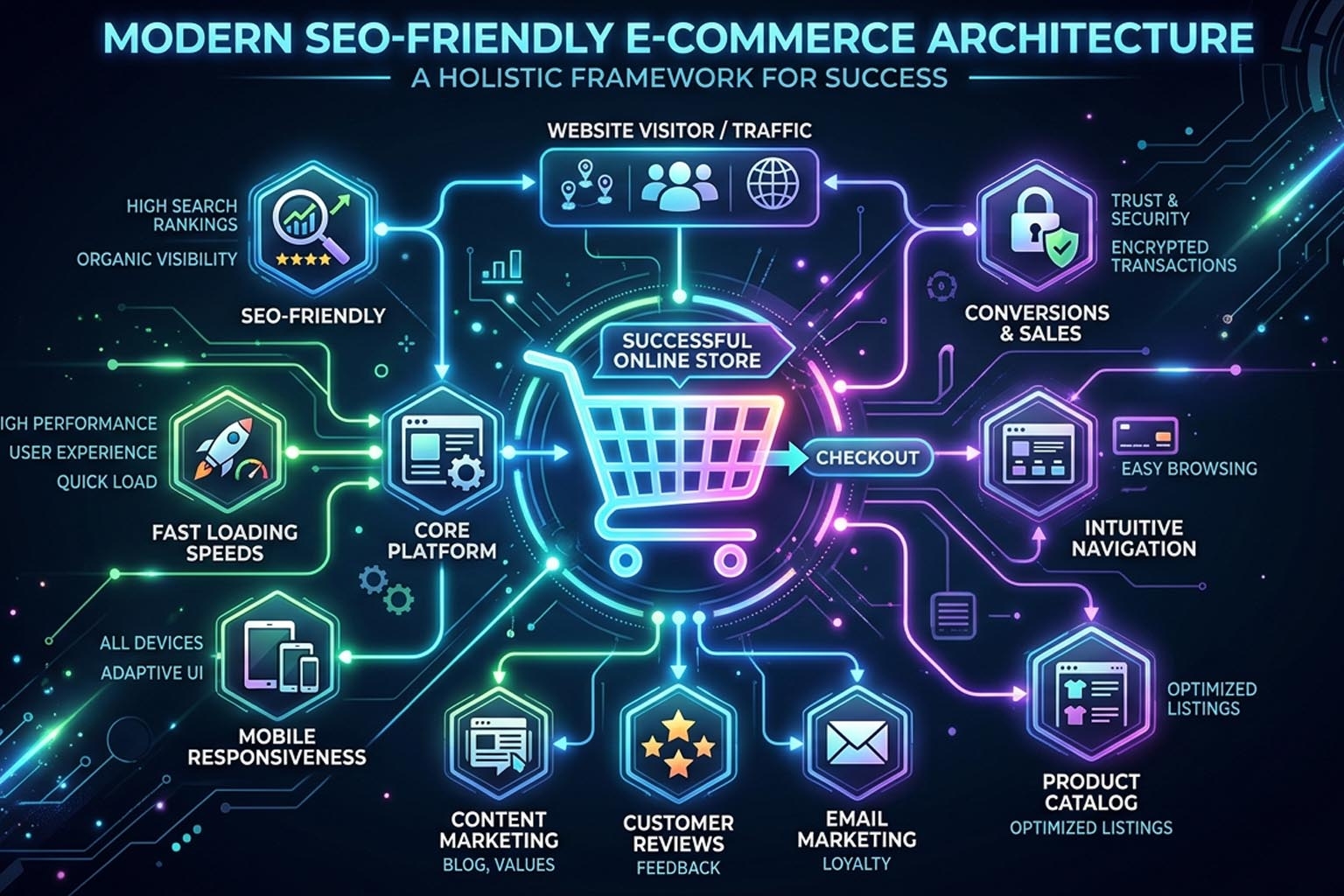
SEO-Friendly Website Architecture for Modern Ecommerce Platforms
Many businesses focus heavily on content, keywords, and backlinks when improving SEO. While these factors are important, they often overlook one of the most critical foundations of search engine success: website architecture.
Website architecture refers to how pages, content, categories, products, and navigation are organized across a website.
For ecommerce businesses, a poorly structured website can create problems such as:
- poor search visibility
- indexing issues
- broken user journeys
- lower conversions
- difficult navigation
- inefficient crawling
A well-designed SEO-friendly website architecture helps search engines understand your content while making it easier for visitors to find products, services, and information.
As ecommerce competition continues to grow, website architecture has become one of the most important elements of long-term SEO success.
What Is Website Architecture?
Website architecture is the structural organization of a website.
It defines how:
- pages connect
- categories are organized
- products are grouped
- navigation works
- URLs are structured
- content is linked
Good architecture helps both users and search engines understand the hierarchy and purpose of your website.
Think of website architecture as the blueprint of your digital business.
Without a clear structure, even high-quality content can struggle to rank effectively.
Why Website Architecture Matters for Ecommerce SEO
Ecommerce websites often contain:
- product pages
- category pages
- landing pages
- blogs
- support content
- FAQs
- account areas
As websites grow, managing this content becomes increasingly complex.
A strong website structure helps:
- improve crawlability
- increase indexation
- distribute SEO authority
- improve navigation
- enhance user experience
- support scalability
Search engines reward websites that are easy to understand and navigate.
1. Create a Logical Website Hierarchy
One of the most important principles of ecommerce SEO is organizing content logically.
A typical hierarchy might look like:
Home
→ Categories
→ Subcategories
→ Products
For example:
Home
→ Electronics
→ Smartphones
→ Product Page
This structure helps search engines understand relationships between pages.
It also helps users find products faster.
A logical hierarchy improves both usability and SEO performance.
2. Keep Important Pages Close to the Homepage
The deeper a page is buried inside a website, the harder it becomes for users and search engines to discover it.
Important pages should ideally be reachable within a few clicks from the homepage.
This includes:
- category pages
- popular products
- service pages
- blog content
- landing pages
Reducing click depth improves:
- crawl efficiency
- page discovery
- user experience
while helping search engines prioritize important content.
3. Use SEO-Friendly URL Structures
URLs play a significant role in website architecture.
Good ecommerce URLs should be:
- readable
- descriptive
- concise
- keyword relevant
Example:
Good:/electronics/smartphones/iphone-15
Poor:/product?id=4839&cat=12
Clean URL structures help search engines understand page context and improve user trust.
4. Build Strong Internal Linking
Internal linking is one of the most overlooked SEO opportunities.
Strategic internal links help:
- distribute page authority
- improve crawlability
- increase page discovery
- guide user journeys
Ecommerce websites should connect:
- categories
- products
- blogs
- FAQs
- support content
- landing pages
through relevant internal links.
A strong internal linking structure helps search engines understand content relationships more effectively.
5. Create Search-Friendly Navigation
Navigation menus should help users quickly find what they need.
Good navigation systems include:
- clear categories
- logical grouping
- intuitive menus
- consistent structure
Avoid overly complicated navigation systems that confuse users or hide important content.
Simple navigation improves:
- engagement
- conversions
- crawlability
- usability
simultaneously.
6. Optimize Category and Collection Pages
Many ecommerce businesses focus entirely on product pages.
However, category pages often rank more effectively because they target broader search intent.
Category pages should include:
- optimized titles
- descriptive content
- internal links
- structured organization
- SEO metadata
Strong category pages become powerful entry points for organic traffic.
7. Ensure Mobile-Friendly Architecture
Most ecommerce traffic now originates from mobile devices.
A website structure that works perfectly on desktop but becomes confusing on mobile creates significant SEO and conversion problems.
Modern ecommerce architecture should support:
- responsive layouts
- touch-friendly navigation
- mobile-first usability
- fast loading experiences
Search engines increasingly prioritize mobile user experience as a ranking factor.
8. Improve Website Performance
Performance and architecture are closely connected.
Large ecommerce websites often suffer from:
- bloated code
- excessive plugins
- unnecessary scripts
- slow page rendering
These issues can negatively impact:
- rankings
- conversions
- user engagement
Modern ecommerce platforms should focus on:
- optimized architecture
- streamlined functionality
- centralized management
to maintain strong performance.
9. Use Structured Content Organization
SEO-friendly websites organize content into clearly defined sections.
Examples include:
- Products
- Categories
- Blog Articles
- FAQs
- Resources
- Support Pages
This improves both user understanding and search engine comprehension.
Structured content also creates opportunities for stronger internal linking and topic authority.
10. Plan for Scalability
Many websites are designed only for current needs.
As businesses grow, they add:
- new products
- new categories
- new content
- new services
Without scalable architecture, websites become difficult to manage.
A future-ready architecture supports growth without requiring major restructuring.
Scalability is especially important for ecommerce businesses planning long-term expansion.
Common Architecture Mistakes That Hurt SEO
Many ecommerce websites struggle because of:
- duplicate content
- poor navigation
- excessive URL parameters
- orphan pages
- weak internal linking
- fragmented content structures
- inconsistent page hierarchy
These issues make it harder for search engines to crawl and understand the website effectively.
How Round Rockk and Rockk Craft Support SEO-Friendly Architecture
Round Rockk and Rockk Craft are designed to help businesses build websites with structured, scalable architecture.
The platform provides:
- custom URL management
- SEO metadata controls
- structured page organization
- visual content management
- responsive design controls
- integrated ecommerce functionality
inside one centralized system.
This allows businesses to create SEO-friendly websites without relying heavily on plugins or external tools.
SEO, Ecommerce, and Website Management in One Platform
Modern businesses increasingly want platforms that combine:
- website management
- ecommerce operations
- SEO controls
- analytics
- security
- content publishing
inside a unified environment.
Rockk Craft supports this approach through integrated management tools designed for scalability and search visibility.
The Future of Ecommerce SEO
Search engines continue to evolve, but one principle remains consistent:
Well-structured websites perform better.
The future of ecommerce SEO depends on:
- strong architecture
- quality content
- user experience
- performance optimization
- scalable infrastructure
Businesses that build these foundations today will be better positioned for long-term organic growth.
Conclusion
SEO-friendly website architecture is one of the most important foundations of ecommerce success.
A well-structured website improves crawlability, indexing, user experience, scalability, and search visibility.
Businesses that invest in logical navigation, clean URLs, strong internal linking, responsive design, and scalable architecture create a stronger foundation for long-term growth.
Round Rockk and Rockk Craft help businesses build modern ecommerce websites with integrated SEO tools, structured content management, and scalable website architecture designed for sustainable growth.
FAQ
What is website architecture in SEO?
Website architecture is the structural organization of pages, content, navigation, and URLs that helps users and search engines understand a website.
Why is website architecture important for ecommerce?
Good architecture improves crawlability, indexing, user experience, navigation, and search rankings.
What makes a URL SEO-friendly?
SEO-friendly URLs are descriptive, readable, concise, and relevant to the page content.
How does internal linking improve SEO?
Internal links help distribute authority, improve crawlability, and guide users through relevant content.
Does Rockk Craft support SEO-friendly website structures?
Yes. Rockk Craft includes URL management, SEO metadata controls, structured content organization, and integrated ecommerce management.
Want to build an ecommerce website with SEO-friendly architecture from day one?
Discover how Round Rockk and Rockk Craft help businesses create scalable websites with integrated SEO controls, visual website management, and modern ecommerce capabilities.
