
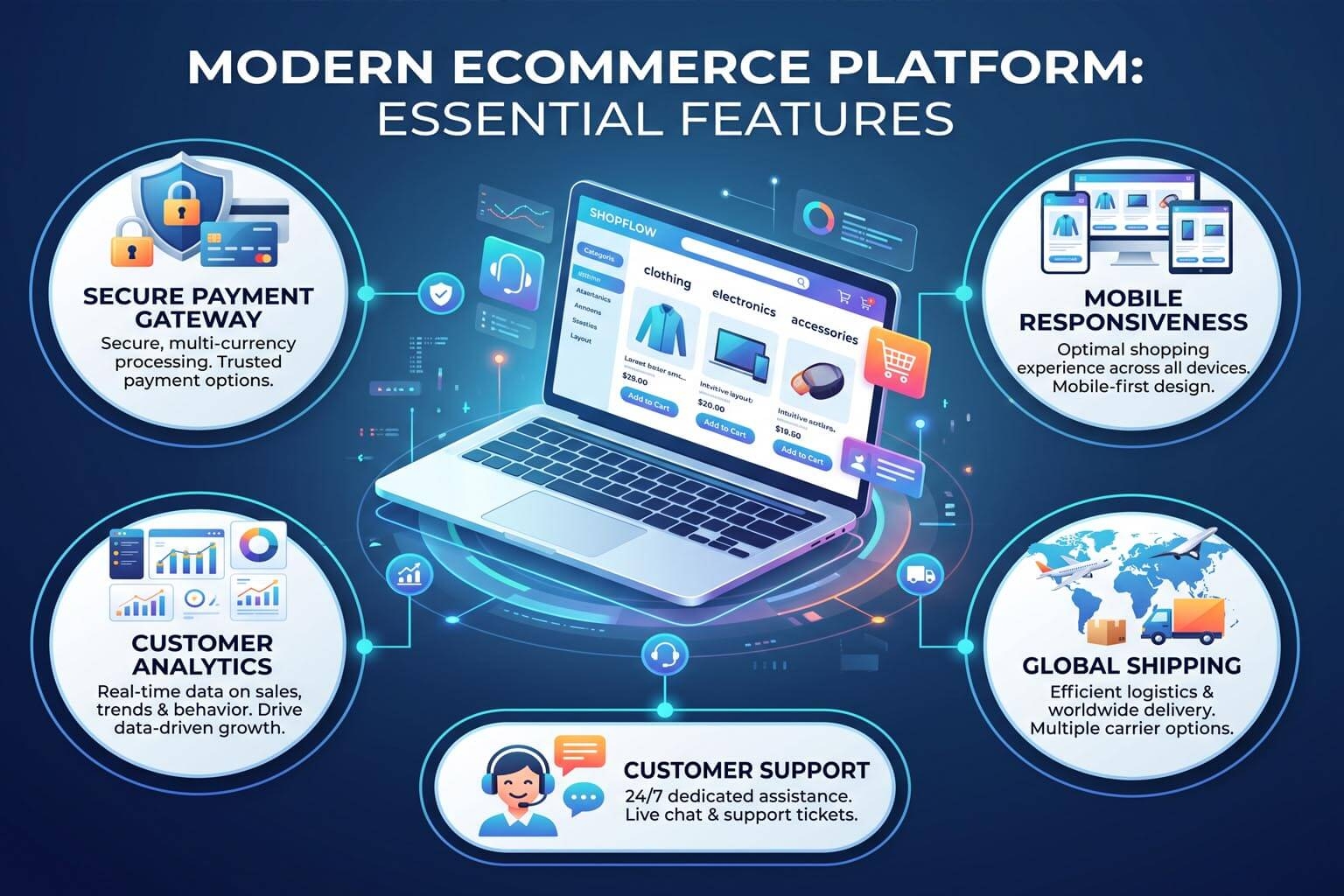
Features Every Modern Ecommerce Platform Should Have
Building an online store is easier than ever.
A business can choose a theme, upload products, connect a payment gateway, and start selling online.
But launching an online store and building a successful e-commerce business are two different things.
Modern customers expect websites to be fast, secure, easy to navigate, mobile-friendly, and available whenever they want to shop. Businesses, meanwhile, need tools that make it easy to manage products, orders, customers, content, marketing, and growth.
That's why choosing an e-commerce platform shouldn't be based simply on how quickly you can create a store.
A modern e-commerce platform should provide the infrastructure and capabilities needed to support the entire customer journey—from discovering a product to completing a purchase and returning for another one.
Here are the features every modern e-commerce platform should have.
1. A Powerful Website Builder
An online store is more than a product catalog.
Businesses need landing pages, promotional pages, blogs, FAQs, about pages, campaigns, and other content that supports the customer journey.
A modern e-commerce platform should therefore provide website-building capabilities alongside its commerce functionality.
Businesses should be able to create and customize:
-
Homepages
-
Product pages
-
Category pages
-
Landing pages
-
Promotional campaigns
-
Blogs
-
FAQs
-
Contact pages
-
About pages
The website and store should feel like one unified experience rather than two separate systems.
2. Flexible Product Management
Product management is at the center of every e-commerce business.
A modern platform should make it easy to manage:
-
Product names
-
Descriptions
-
Images
-
Videos
-
Categories
-
Pricing
-
Discounts
-
Variants
-
Inventory
-
Product attributes
-
SEO information
It should also be easy to update products in bulk as a store grows.
For a business with hundreds or thousands of products, inefficient product management can quickly become a major operational problem.
3. Mobile-First Design
A modern e-commerce platform must treat mobile as a primary shopping experience—not an afterthought.
Customers should be able to:
-
Browse products
-
Search
-
Filter
-
View images
-
Read descriptions
-
Add products to their cart
-
Complete checkout
-
Manage their accounts
comfortably from a smartphone.
A responsive layout is important, but mobile optimization goes beyond simply making desktop pages smaller.
Navigation, buttons, images, forms, checkout, and page performance all need to work well on smaller screens.
4. Fast Page Performance
Speed matters at every stage of an online shopping journey.
A slow product page can cause customers to leave.
A slow category page can make browsing frustrating.
A slow checkout can create uncertainty at exactly the point where the customer is ready to purchase.
A modern platform should therefore be designed around performance.
Important capabilities can include:
-
Efficient page rendering
-
Caching
-
CDN support
-
Optimized images
-
Efficient asset delivery
-
Lightweight page structures
-
Browser caching
-
Scalable server infrastructure
Performance shouldn't be something businesses have to discover and fix after their store becomes slow.
It should be part of the platform's architecture.
5. Strong SEO Controls
An e-commerce platform should not treat SEO as an optional add-on.
Businesses need control over important search engine optimization elements such as:
-
Page titles
-
Meta descriptions
-
URLs
-
Canonical URLs
-
Heading structure
-
Image alt text
-
Internal links
-
Structured data
-
XML sitemaps
-
Indexing controls
The platform should also make it possible to optimize product, category, and content pages independently.
A beautiful store is not very useful if potential customers cannot discover it through search engines.
6. Clean URL Management
URLs are an often-overlooked part of e-commerce SEO.
A good platform should allow businesses to create readable, logical URLs.
For example:
example.com/products/modern-office-chair
is generally more useful and understandable than a URL filled with unnecessary parameters or automatically generated identifiers.
Businesses should also have appropriate controls when changing URLs, including redirects where necessary.
As a store grows, URL management becomes increasingly important.
7. Secure Payments
Customers need confidence when entering payment information.
A modern e-commerce platform should provide secure payment processing through reputable payment providers and follow appropriate security practices.
Depending on the business, payment capabilities may include:
-
Credit and debit cards
-
Digital wallets
-
Bank transfers
-
Local payment methods
-
Buy-now-pay-later services
-
Multiple currencies
The checkout process should also be clear about payment status and provide reliable handling of successful and failed transactions.
8. Secure Customer Accounts
Many e-commerce businesses need customer accounts for:
-
Order history
-
Addresses
-
Saved information
-
Wishlist functionality
-
Returns
-
Account preferences
Account security should therefore be treated as a core platform responsibility.
Modern platforms should provide appropriate protections such as secure authentication, password handling, session management, and protection against common attacks.
Businesses should not have to assemble their customer security model from a collection of unrelated extensions.
9. Reliable Shopping Cart and Checkout
The checkout is one of the most important parts of an online store.
A modern platform should make checkout:
-
Fast
-
Clear
-
Mobile-friendly
-
Secure
-
Easy to understand
Customers shouldn't have to navigate unnecessary steps just to purchase a product.
Businesses should also be able to customize relevant aspects of the checkout experience without breaking the underlying transaction process.
10. Inventory Management
As an online store grows, inventory becomes increasingly complex.
A platform should provide tools to track:
-
Available stock
-
Product variants
-
Low-stock products
-
Out-of-stock items
-
Inventory changes
-
Orders affecting stock
For larger businesses, integration with external inventory or enterprise systems may also be necessary.
The important point is that inventory shouldn't become a separate problem disconnected from the online store.
11. Order Management
Selling a product is only the beginning.
Businesses need to manage what happens afterward.
A modern platform should make it easy to:
-
View orders
-
Track order status
-
Process payments
-
Handle cancellations
-
Manage refunds
-
Update fulfillment status
-
Access customer information
-
Review order history
Order management should be simple enough for daily operations but flexible enough to support growing businesses.
12. Customer Management
Customer data can help businesses understand who is buying from them and how those customers interact with the store.
A modern e-commerce platform should provide useful customer information while respecting privacy and security requirements.
Businesses may need to understand:
-
Purchase history
-
Order frequency
-
Customer value
-
Account information
-
Communication preferences
-
Previous interactions
This information can support better customer service and more relevant marketing.
13. Search and Filtering
As product catalogs grow, navigation becomes increasingly important.
Imagine a store with 5,000 products but no useful filtering.
Customers may have to scroll through hundreds of products to find what they want.
A modern platform should support:
-
Product search
-
Categories
-
Filters
-
Sorting
-
Attributes
-
Price ranges
-
Availability filters
Good product discovery can make the difference between a customer finding the right product and leaving the website.
14. Analytics and Reporting
An e-commerce business needs more than a simple order count.
Businesses should be able to understand:
-
Which products sell best
-
Where customers come from
-
Which pages generate conversions
-
Which campaigns perform well
-
Where customers abandon the purchase process
-
How revenue changes over time
Analytics turn website activity into business information.
A modern platform should provide useful reporting or integrate cleanly with established analytics systems.
15. Marketing Tools
E-commerce doesn't end when a website is launched.
Businesses need to attract customers and bring them back.
Useful capabilities can include:
-
Discount codes
-
Promotional campaigns
-
Product recommendations
-
Abandoned-cart recovery
-
Customer segmentation
-
Email integrations
-
Social media integrations
-
Promotional landing pages
Marketing should work alongside the store rather than requiring businesses to manually connect unrelated systems for every campaign.
16. Content and Blogging
Content marketing can be a powerful way to attract potential customers.
A modern e-commerce platform should therefore provide more than product pages.
Businesses should be able to publish:
-
Articles
-
Buying guides
-
Product comparisons
-
Tutorials
-
FAQs
-
Industry insights
-
Customer stories
This content can attract organic search traffic and help customers make purchasing decisions.
The combination of content + commerce is particularly powerful because customers can move directly from education to product discovery.
17. Image and Media Management
E-commerce websites are highly visual.
Businesses may have thousands of:
-
Product images
-
Videos
-
Banners
-
Logos
-
Documents
-
Marketing assets
A modern platform should make media management straightforward.
It should also support appropriate optimization so that visual content doesn't unnecessarily slow down the website.
High-quality images shouldn't require customers to download enormous files just to view a product.
18. Built-In Security
Security should not be treated as something businesses add later.
An e-commerce platform handles valuable information, including customer accounts, orders, and potentially payment-related data.
A modern platform should be designed with security throughout its architecture.
Important areas include:
-
Authentication
-
Access control
-
Secure sessions
-
Input validation
-
Protection against common web attacks
-
Monitoring
-
Rate limiting
-
Secure APIs
-
Regular security maintenance
Businesses should be able to focus on selling rather than constantly worrying about whether the next plugin update will create a security problem.
19. APIs and Integrations
No platform can provide every possible feature.
Businesses will always need specialized tools.
That's why modern e-commerce platforms should provide reliable APIs and integration capabilities.
These can connect stores with:
-
Accounting systems
-
Shipping providers
-
CRM platforms
-
Marketing systems
-
Inventory software
-
ERP systems
-
Analytics tools
-
Customer support platforms
An all-in-one platform shouldn't mean an isolated platform.
It should provide integrated core functionality while remaining extensible when businesses need additional capabilities.
20. Scalability
A platform that works for a small store should not necessarily force the business to migrate when it becomes successful.
Scalability can involve:
-
More products
-
More customers
-
More orders
-
More traffic
-
More content
-
Larger media libraries
-
Multiple domains
-
Additional business operations
Businesses should consider scalability before choosing a platform, rather than waiting until the existing system becomes a bottleneck.
21. Multi-Channel Capabilities
Customers don't always discover products directly through a store's homepage.
They may come from:
-
Search engines
-
Social media
-
Email
-
Advertising
-
Marketplaces
-
Content
-
Direct links
A modern e-commerce platform should make it possible to build a consistent experience across different customer acquisition channels.
The store should remain the central destination while allowing businesses to reach customers wherever they discover products.
22. Flexible Design Without Developer Dependency
Businesses shouldn't need a developer every time they want to:
-
Change a headline
-
Add a section
-
Update a product
-
Create a landing page
-
Change a banner
-
Publish an article
A visual editor can give businesses greater independence.
However, visual editing should not mean sacrificing control.
The ideal platform combines:
Ease of use + design flexibility + technical capability
That allows marketers and business owners to handle routine work while developers can focus on more complex requirements.
23. Multi-Domain and Multi-Store Support
Growing businesses may eventually operate:
-
Multiple brands
-
Regional websites
-
Separate storefronts
-
Different domains
-
Multiple product catalogs
A platform capable of supporting multiple websites or domains can reduce the need to manage completely separate technology stacks.
This can be particularly valuable for agencies and businesses with multiple brands.
24. Reliable Infrastructure
The storefront is only one part of an e-commerce platform.
Behind it is an infrastructure layer responsible for delivering pages, handling requests, storing data, and processing transactions.
Businesses should consider:
-
Hosting architecture
-
Database performance
-
CDN capabilities
-
Caching
-
Backup systems
-
Monitoring
-
Availability
-
Recovery processes
A modern e-commerce platform should be designed to remain reliable as traffic and business requirements grow.
25. Easy Data Management and Portability
Businesses should never forget that their website contains valuable assets.
Products, content, customer information, orders, media, and business data can represent years of work.
Before choosing a platform, businesses should understand how data is stored, managed, exported, and migrated.
A platform should make it clear what the business owns and what options are available if the business eventually needs to change its technology.
The Best E-Commerce Platform Isn't the One With the Most Features
It's tempting to compare platforms by counting features.
One platform has 100 features.
Another has 150.
Therefore, the second must be better.
Not necessarily.
A better question is:
How well do the features work together?
An e-commerce platform with dozens of disconnected tools can be more difficult to manage than a platform with fewer but better-integrated capabilities.
The real value comes from the combination of:
Performance + Security + SEO + E-Commerce + Website Building + Scalability + Ease of Use
These capabilities should support each other rather than operate as isolated systems.
Why Integration Matters
Consider a business that needs:
-
A website builder
-
An e-commerce system
-
SEO tools
-
Security software
-
Hosting
-
CDN
-
Analytics
-
Image optimization
-
Forms
-
Marketing integrations
If every capability comes from a different provider, the business may end up maintaining a complex technology stack.
An integrated platform can simplify this architecture.
That doesn't mean external services should disappear.
Instead, the platform should provide the essential capabilities businesses need while offering APIs and integrations for specialized requirements.
Where RoundRockk Fits
RoundRockk is designed around this philosophy.
Instead of treating website building and e-commerce as completely separate products, RoundRockk brings them together within an integrated platform.
The goal is to provide businesses with the ability to visually create and manage their websites while also supporting the requirements of a modern online store.
That includes areas such as:
-
Website and page creation
-
E-commerce
-
SEO controls
-
Security
-
Performance
-
Content management
-
Media management
-
Scalable infrastructure
-
Integrations
-
Multi-domain capabilities
The idea is straightforward:
Businesses shouldn't have to assemble their entire online presence from a collection of disconnected tools.
At the same time, an integrated platform should not lock businesses into a rigid system.
The best approach is to provide powerful built-in capabilities while maintaining the flexibility to integrate with external services when needed.
Final Thoughts
A modern e-commerce platform needs to do much more than display products and process payments.
It needs to support the entire online business.
That means providing a combination of:
-
A flexible website builder
-
E-commerce functionality
-
Fast performance
-
Mobile-first experiences
-
SEO controls
-
Secure payments
-
Customer management
-
Inventory and order management
-
Analytics
-
Marketing tools
-
Strong security
-
APIs and integrations
-
Scalability
-
Reliable infrastructure
But the most important feature may be something that doesn't appear on a feature list:
simplicity.
Businesses should be able to manage their online presence without constantly dealing with technical complexity.
The future of e-commerce isn't simply about adding more features.
It's about bringing the right features together into a platform that is fast, secure, flexible, scalable, and easy to manage.
That's what a modern e-commerce platform should deliver.
