
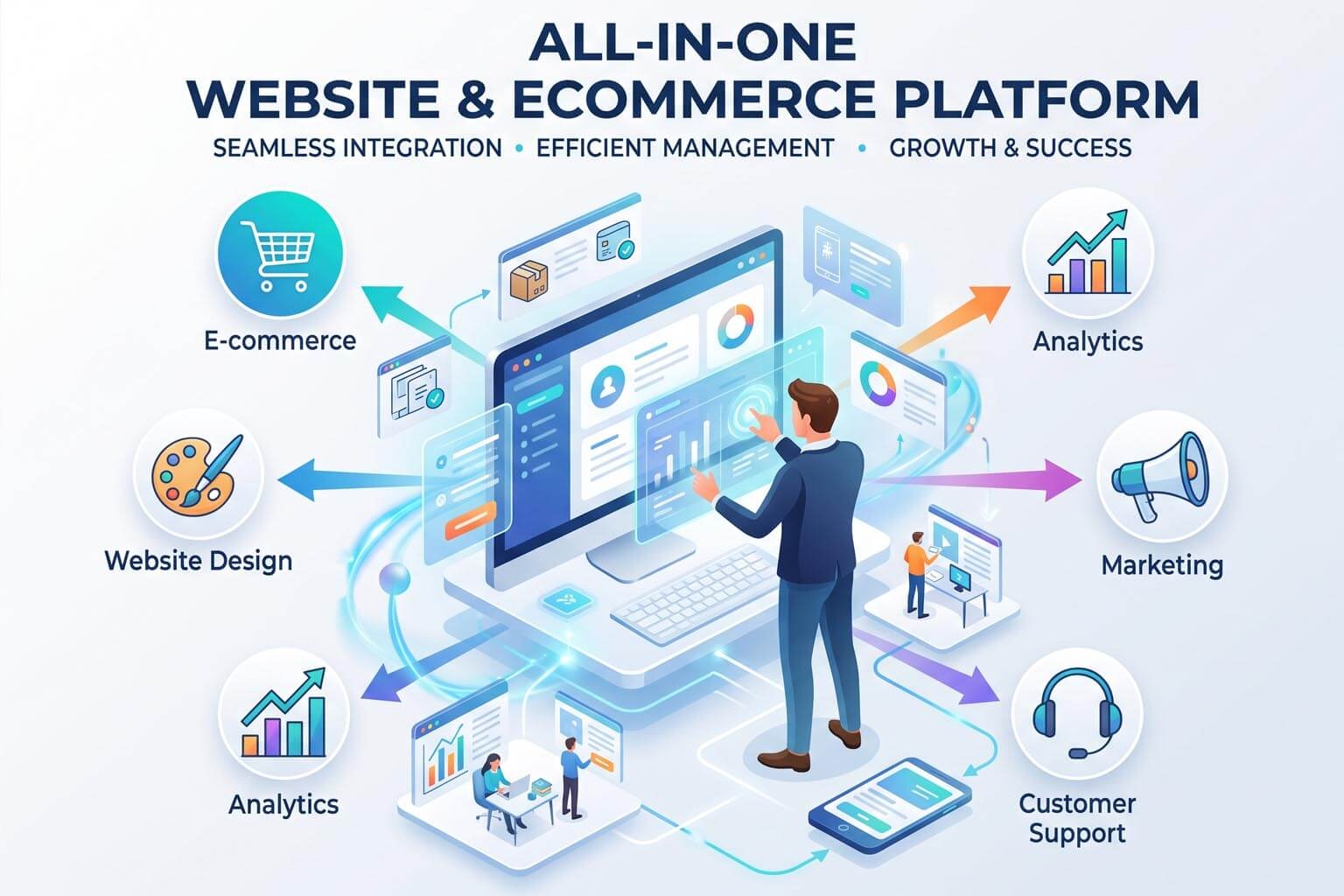
The Benefits of Using an All-in-One Website and Ecommerce Platform
Running an online business often means managing much more than a website.
There may be a website builder, e-commerce system, hosting provider, payment gateway, analytics platform, security tools, CDN, SEO plugins, email services, and several other technologies working together behind the scenes.
Each tool may solve a specific problem, but managing all of them can become complicated.
This is where an all-in-one website and e-commerce platform can make a significant difference.
Instead of connecting multiple systems together, an all-in-one platform brings essential website and e-commerce capabilities into a unified environment.
For businesses that want to launch quickly, reduce technical complexity, and scale efficiently, this approach can offer several important advantages.
What Is an All-in-One Website and E-Commerce Platform?
An all-in-one website and e-commerce platform combines the tools needed to build, manage, and operate an online business within one platform.
Depending on the platform, this may include:
-
Website design and development
-
E-commerce functionality
-
Product management
-
Shopping carts and checkout
-
Content management
-
SEO controls
-
Hosting
-
Security
-
Analytics
-
Media management
-
Payment integrations
-
CDN and performance features
-
Domain management
Instead of maintaining separate systems for each function, businesses can manage their online presence from a centralized platform.
This can be particularly useful for small and medium-sized businesses that don't have dedicated technical teams.
1. Simpler Website Management
One of the biggest advantages of an all-in-one platform is simplicity.
With a traditional setup, a business might have to manage:
Website → Hosting → CMS → Plugins → E-commerce → Payment system → CDN → Security → Analytics
Each component can have its own dashboard, settings, updates, documentation, and support process.
An integrated platform can reduce this complexity.
Instead of asking:
"Which system is causing this problem?"
business owners can manage most of their website and e-commerce requirements from a single environment.
This makes everyday management easier and reduces the technical knowledge required to operate an online business.
2. Fewer Integrations to Maintain
Integrations are useful, but every integration introduces another dependency.
For example, a business might connect its website to several external systems for:
-
Payments
-
Product management
-
Customer accounts
-
Analytics
-
Marketing
-
Security
-
Shipping
-
Inventory
When one system changes its API, authentication method, pricing, or technical requirements, another part of the website may need to be updated.
An all-in-one platform can reduce the number of connections between independent systems.
Fewer dependencies can mean fewer opportunities for something to break.
3. Faster Website Launch
Traditional custom development can take weeks or months depending on the complexity of a project.
An all-in-one platform can significantly reduce the time required to launch because many fundamental components are already available.
Businesses can start with:
-
Pre-built website structures
-
Reusable sections
-
Product components
-
E-commerce functionality
-
Forms
-
Navigation
-
SEO controls
-
User management
This allows a business to spend more time working on its content, products, branding, and customers instead of rebuilding basic infrastructure.
4. Website and E-Commerce Work Together
A major advantage of an integrated platform is that the website and store don't have to operate as separate systems.
A business can combine:
-
Landing pages
-
Product pages
-
Blog content
-
Categories
-
Offers
-
Forms
-
Customer accounts
-
Shopping carts
-
Checkout
-
Orders
within the same ecosystem.
This creates a more consistent customer experience.
For example, a visitor can discover a product through a blog article, move to the product page, add the product to their cart, and complete the purchase without being sent through unrelated systems.
5. Better Brand Consistency
When a business uses different systems for its website, store, landing pages, and content, maintaining a consistent design can become difficult.
Customers may notice differences in:
-
Fonts
-
Colors
-
Navigation
-
Buttons
-
Page layouts
-
Checkout design
-
Mobile experience
An integrated platform makes it easier to maintain a consistent visual language throughout the customer journey.
The website should feel like one business—not several systems stitched together.
6. Reduced Technical Complexity
Technology becomes more complicated as a business grows.
A website might start with only a few pages.
Then the business adds:
-
Products
-
Blogs
-
Customer accounts
-
Payment systems
-
Marketing integrations
-
Analytics
-
Forms
-
Promotions
-
Additional domains
-
New sales channels
Eventually, managing everything can become a project of its own.
An all-in-one platform can reduce this operational complexity by bringing many functions under one roof.
This is particularly valuable for businesses without an in-house development team.
7. Centralized Security
Security is another important consideration.
A traditional website stack may require businesses to think about security at multiple levels:
-
CMS security
-
Plugin security
-
Hosting security
-
Server configuration
-
Authentication
-
Database security
-
API security
-
Payment integrations
An all-in-one platform can centralize many of these responsibilities.
This doesn't eliminate the need for good security practices, but it can reduce the number of systems that businesses have to monitor and maintain.
8. Easier Performance Optimization
Website performance depends on many different components.
A slow website could be caused by:
-
Poor hosting
-
Large images
-
Excessive JavaScript
-
Slow plugins
-
Database queries
-
External services
-
Poor caching
-
Unoptimized themes
When different systems are connected together, identifying the source of a performance problem can become difficult.
An integrated platform has greater control over the complete delivery process.
This makes it easier to coordinate:
-
Page generation
-
Caching
-
Asset delivery
-
Image optimization
-
CDN usage
-
Server resources
The result can be a more consistent and predictable website experience.
9. Better SEO Management
Search engine optimization isn't just about adding keywords to a page.
Modern SEO involves many technical and content-related factors, including:
-
Page titles
-
Meta descriptions
-
URLs
-
Structured content
-
Site architecture
-
Mobile usability
-
Page speed
-
Internal linking
-
Indexability
-
Image optimization
When these controls are spread across multiple systems, managing SEO can become unnecessarily complicated.
An all-in-one platform can provide centralized control over important SEO elements.
This makes it easier for businesses to maintain optimization as their website grows.
10. Easier E-Commerce Management
An online store requires more than product pages.
Businesses have to manage:
-
Products
-
Categories
-
Pricing
-
Inventory
-
Orders
-
Customers
-
Payments
-
Promotions
-
Content
-
Shipping
-
Returns
When the website and e-commerce system are integrated, these functions can be managed as part of the same business environment.
This can reduce duplicated work and make it easier to maintain consistency across the store.
11. Easier Scaling
A platform that works for ten products should ideally be capable of supporting hundreds or thousands of products as the business grows.
The same applies to:
-
Traffic
-
Content
-
Domains
-
Customers
-
Orders
-
Media
-
Marketing campaigns
A well-designed all-in-one platform can provide a foundation for scaling without requiring the business to completely rebuild its technology stack every time it grows.
However, scalability should always be evaluated carefully. Not every platform that calls itself "all-in-one" is designed for significant growth.
12. Lower Operational Complexity
The cost of technology isn't limited to subscription fees.
Businesses also spend money and time on:
-
Developers
-
Maintenance
-
Plugin updates
-
Security monitoring
-
Troubleshooting
-
Integration development
-
Hosting management
-
Performance optimization
An all-in-one platform can reduce some of these operational costs by consolidating multiple responsibilities.
The biggest benefit may not be saving money on individual software subscriptions.
It may be saving the time and effort required to keep everything working together.
13. One Platform Can Mean One Workflow
Imagine creating a new product.
In a fragmented setup, you might have to:
-
Create the product in the e-commerce system.
-
Add images somewhere else.
-
Create a landing page in the website builder.
-
Configure SEO through another tool.
-
Add analytics tracking.
-
Connect marketing software.
-
Configure additional integrations.
With an integrated platform, much of this workflow can happen in one environment.
The fewer steps required to perform routine tasks, the easier it becomes to manage a growing online business.
14. Easier for Small and Medium-Sized Businesses
Large companies can afford dedicated development, infrastructure, security, and marketing teams.
Small businesses often cannot.
For them, complexity has a real cost.
Every additional system means another dashboard to learn, another subscription to pay, and another technology dependency to maintain.
An all-in-one platform allows smaller businesses to access capabilities that would otherwise require a much larger technical operation.
Is an All-in-One Platform Always Better?
Not necessarily.
There are situations where using specialized systems makes sense.
A large enterprise may require highly customized infrastructure, specialized databases, proprietary applications, or integrations with internal systems.
In such cases, a custom technology stack may provide more flexibility.
There is also a potential downside to all-in-one platforms: platform dependency.
Businesses should evaluate whether the platform provides sufficient control over their data, content, domains, integrations, performance, and future growth.
The goal shouldn't be to put everything into one system simply for the sake of simplicity.
The goal should be to find the right balance between simplicity, flexibility, performance, and control.
All-in-One Doesn't Have to Mean Limited
An all-in-one platform used to imply a compromise.
Businesses often had to choose between:
Easy to use
or
Powerful and customizable
Modern platforms are increasingly trying to close that gap.
A good platform can provide visual tools for everyday users while still providing the infrastructure, APIs, security controls, SEO capabilities, and scalability required by growing businesses.
This creates a more practical middle ground between traditional website builders and fully custom development.
What Should You Look for in an All-in-One Platform?
Before choosing a platform, businesses should evaluate more than its feature list.
Look at:
Website flexibility
Can you create the designs and layouts your business actually needs?
E-commerce capabilities
Can you manage products, customers, orders, payments, and the purchasing experience effectively?
SEO controls
Can you control titles, descriptions, URLs, structured content, and other important SEO elements?
Performance
Does the platform provide efficient page delivery, caching, CDN support, and optimized assets?
Security
Does the platform provide meaningful security controls and protection against common attacks?
Scalability
Can the platform handle your expected growth?
Data and ownership
Can you access and manage your content and business data?
Integrations
Does it provide APIs or other mechanisms for connecting the services you actually need?
Ease of use
Can your team manage the website without depending on a developer for every small change?
These questions are often more important than simply counting how many features a platform offers.
The Future of Website and E-Commerce Development
The traditional approach to building an online business often involves assembling many different technologies.
That approach isn't going away completely.
But there is a growing demand for platforms that simplify the process without sacrificing flexibility.
Businesses want to:
-
Build faster
-
Manage websites more easily
-
Sell online
-
Improve performance
-
Maintain security
-
Control SEO
-
Scale efficiently
without becoming technology companies themselves.
This is where all-in-one website and e-commerce platforms can provide significant value.
Where RoundRockk Fits
RoundRockk is built around the idea that businesses shouldn't have to choose between simplicity and control.
A modern website platform should make it possible to visually create and manage websites while providing the capabilities needed for serious online businesses.
Instead of assembling a website from multiple disconnected technologies, businesses can use an integrated platform for their website, content, e-commerce capabilities, and other essential functionality.
The objective isn't simply to provide another website builder.
It's to make running an online business simpler, more scalable, and less dependent on a collection of disconnected tools.
Final Thoughts
An all-in-one website and e-commerce platform can simplify the technology behind an online business.
By bringing website creation, e-commerce, content management, SEO, performance, security, and other capabilities into a more unified environment, businesses can reduce complexity and spend more time focusing on their customers.
However, "all-in-one" should never mean "one-size-fits-all."
The best platform is one that combines convenience with flexibility, performance, security, scalability, and control.
For many businesses, that balance can provide a more practical alternative to managing a collection of separate systems—or paying for a completely custom technology stack.
The future of online business isn't necessarily about using more tools. It may be about using better-integrated ones.
